From the Caucus to the Balkans: Who Are the People Celebrating Newroz?
Newroz is a ritual of renewal that carries within it layers of myth, resistance, seasonal change, and civilizational continuity stretching back thousands of years. From the Caucasus to the Balkans, and across the Persian plateau into Central and South Asia, Newroz endures as one of the most quietly powerful cultural inheritances in human history.
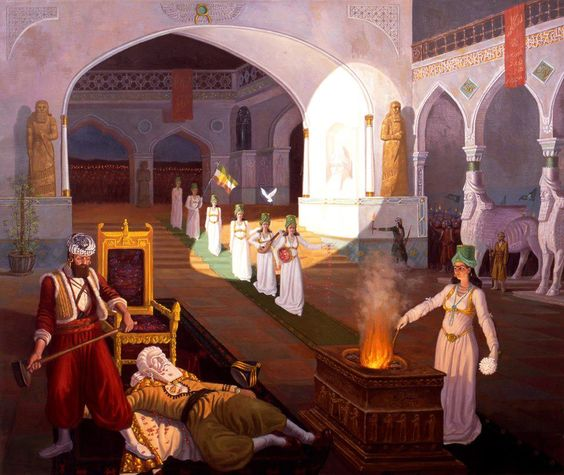
At its deepest historical root, Newroz emerges from ancient Indo-Iranian traditions tied to the spring equinox, which is the precise moment when day and night stand in balance, and nature begins its return to life. In pre-Islamic Persia, particularly under the Achaemenid Empire, it became a formalized imperial celebration, marking not only the agricultural cycle but also cosmic harmony and political order. The world was imagined as renewed, cleansed, and rebalanced. Fire, in particular, became central: a symbol of purification, light, and continuity.
Yet, Newroz is not only about nature but also narrative. this occasion is very important for the Kurdish people because it has a long history and many historians say that the Median rule and the Kurdish people long before BC and on the first day of the first Kurdish month liberated Kurdistan from the Assyrians (612 BC). They celebrated this day and called it a new day. Some historians and researchers date the event back 4000 years.
Today, Newroz is celebrated across at least twelve countries, each giving it a slightly different texture while preserving its essence. These include: Iran, Iraq (especially among Kurds), Turkey (primarily by Kurds), Syria (again among Kurdish communities), Azerbaijan, Armenia, Georgia, Kazakhstan, Kyrgyzstan, Uzbekistan, Turkmenistan, and Albania. Across these regions, it transcends ethnic and religious divisions: it is observed by Persians, Kurds, Turks, Central Asian communities, and others, each embedding it within their own histories.
What is remarkable is how Newroz has survived not as a static tradition, but as a living one. It has endured empires, religious transformations, colonial borders, and modern state formations that often sought to suppress or standardize identity. In some contexts, particularly for Kurds, celebrating Newroz was at times an act of quiet defiance, a preservation of language, story, and collective memory under pressure.
And yet, its persistence is not only political. It is existential. Newroz speaks to something fundamental in human experience: the need to mark time not merely as passing, but as renewing. The rituals, such as lighting fires, gathering in nature, wearing bright clothes, preparing symbolic foods are gestures that bridge past and present, the personal and the collective, the earthly and the cosmic.
In a modern world often defined by artificial borders an a narrative of division and uncertainty, Newroz offers something rare: continuity without rigidity. It reminds societies that identity can endure without stagnating, and that renewal is not an abstract idea, but something enacted year after year, generation after generation.
To celebrate Newroz, then, is to participate in a civilizational memory that refuses disappearance. It is to affirm that even after darkness, whether seasonal or political, light returns through both nature’s rhythm and human will.
Source: Specific details about the connection of Newroz to Kurds can be found at KURDSHOP– a cultural organization of the civil society that serves the language, culture, history and arts of the Kurds.