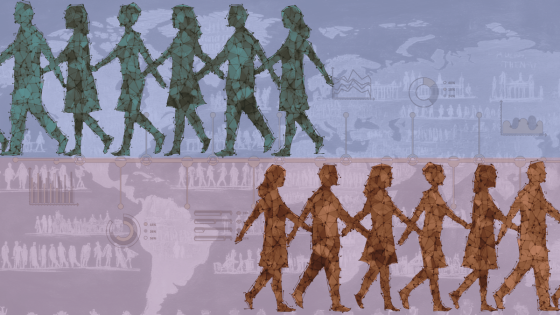

Women in Relation to the World
One is not born, but rather becomes, a woman. Simone de Beauvoir
To speak of women and the forms of knowledge they carry is to move beyond the visible markers of achievement and into a quieter, often unarticulated domain of intelligence, one that is not always codified in institutions yet persistently shapes them from within. There exists, across societies and across time, a distinction that is rarely named directly but often observed in its effects, between women who merely participate in social life and those who seem to move through it with a certain depth of perception, a cultivated awareness of context, language, and human dynamics that allows them not only to navigate complexity but to subtly reorganize it. This is not a matter of innate superiority, nor of romanticized intuition, but of a layered form of knowledge, at once philosophical and practical, that is acquired through attention, discipline, and an enduring engagement with the structures that define civilized life.
One might begin to understand this through the work of Simone de Beauvoir, who in The Second Sex refused the simplification of women’s roles and instead examined the conditions through which women become conscious of themselves in relation to the world. For Beauvoir, the woman who transcends mere immanence does so not by rejecting her social reality, but by interpreting it, by refusing to remain confined within the meanings imposed upon her and instead transforming those meanings through thought and action. This act of interpretation is itself a form of knowledge, one that requires sensitivity to nuance, to contradiction, and to the often invisible expectations that govern behavior. It is here that we begin to see the emergence of what might be called cultivated awareness, a capacity to read situations beyond their surface, to perceive what is said and what is withheld, and to act accordingly.
Yet this awareness is not purely reflective but profoundly practical. The women who distinguish themselves in civilized societies are often those who understand that power does not operate solely through formal authority, but through relationships, perception, and timing. In this sense, their knowledge resembles what Hannah Arendt described as the art of appearing in the public realm, not as spectacle, but as presence. Arendt’s conception of action as something that unfolds among others, that gains meaning through recognition and interaction, offers a framework for understanding how certain women cultivate influence without necessarily occupying the most visible positions of power. They understand that the public sphere is not only a space of speech, but of judgment, where credibility is formed through consistency, composure, and the ability to situate oneself within a broader narrative.
What distinguishes these women, then, is not simply knowledge in the conventional sense, but a synthesis of intellectual and social intelligence, a capacity to think while remaining acutely aware of the relational fabric within which thought must operate. They recognize that ideas do not exist in isolation, that they must be communicated, received, and negotiated, and that this process requires more than correctness; it requires tact, patience, and an understanding of the rhythms of human interaction. This is why their success often appears understated, even effortless, when in fact it is the result of sustained attentiveness to both the visible and the invisible dimensions of social life.
There is also an ethical dimension to this form of knowledge, one that resists reduction to strategy alone. The women who endure, who leave a lasting impression are often those who understand that success is not merely the accumulation of recognition, but the ability to maintain coherence between one’s values and one’s actions. This coherence does not imply rigidity, but rather a kind of internal alignment that allows for adaptability without fragmentation. It is here that their philosophical awareness becomes inseparable from their practical conduct, because to act effectively in complex environments requires not only skill, but a clear sense of what one stands for and why.
At the same time, it would be a mistake to assume that this form of knowledge emerges without constraint or resistance. On the contrary, it is often shaped in response to limitations, to the necessity of navigating spaces that were not designed with women in mind. In this context, what appears as subtlety is often a form of resilience, a way of operating within and against structures simultaneously. The ability to read a room, to anticipate reactions, to choose one’s interventions carefully, is not simply a social grace; it is a cultivated response to conditions that demand both awareness and restraint.
And yet, despite these constraints, or perhaps because of them, such women often succeed, not always in the most visible or conventional terms, but in ways that alter the environments they inhabit. They introduce a different tempo to decision making, a different sensitivity to consequence, a different understanding of what it means to lead or to influence. Their success lies not only in personal advancement, but in the subtle reconfiguration of norms, in the expansion of what is considered possible within a given context.
To understand this is to recognize that the knowledge they yield is neither accidental nor easily replicated, because it is rooted in a continuous engagement with both thought and practice, with the demands of the present and the weight of inherited structures. It is a knowledge that does not announce itself loudly, yet reveals itself in outcomes, in the ability to sustain complexity without being overwhelmed by it, and to act with precision in environments that reward neither haste nor naivety.
The women who distinguish themselves in civilized societies do so by understanding the world more deeply than it expects, and by moving within it with a clarity that is at once intellectual, practical, and profoundly human.
References
Beauvoir, Simone de. The Second Sex.
Arendt, Hannah. The Human Condition.
Bourdieu, Pierre. Distinction: A Social Critique of the Judgement of Taste.