The Examined Life is Worth Living
To think is to command yourself. But how can one command self without the foundations of thinking and understanding? This is one of the key questions that I ask myself all the time. Here, I want to address it, in my own way of thinking, especially by focusing on the sovereign power of philosophical thought and how it shapes one’s understanding of life.
Let’s start with the basics. There is a certain kind of person who moves through life with tremendous confidence and almost no self-knowledge. They accumulate opinions the way others accumulate possessions, never once asking where those opinions came from, who installed them, or whether they bear any resemblance to truth. Socrates called this condition the gravest of human diseases, and he gave his life arguing against it.
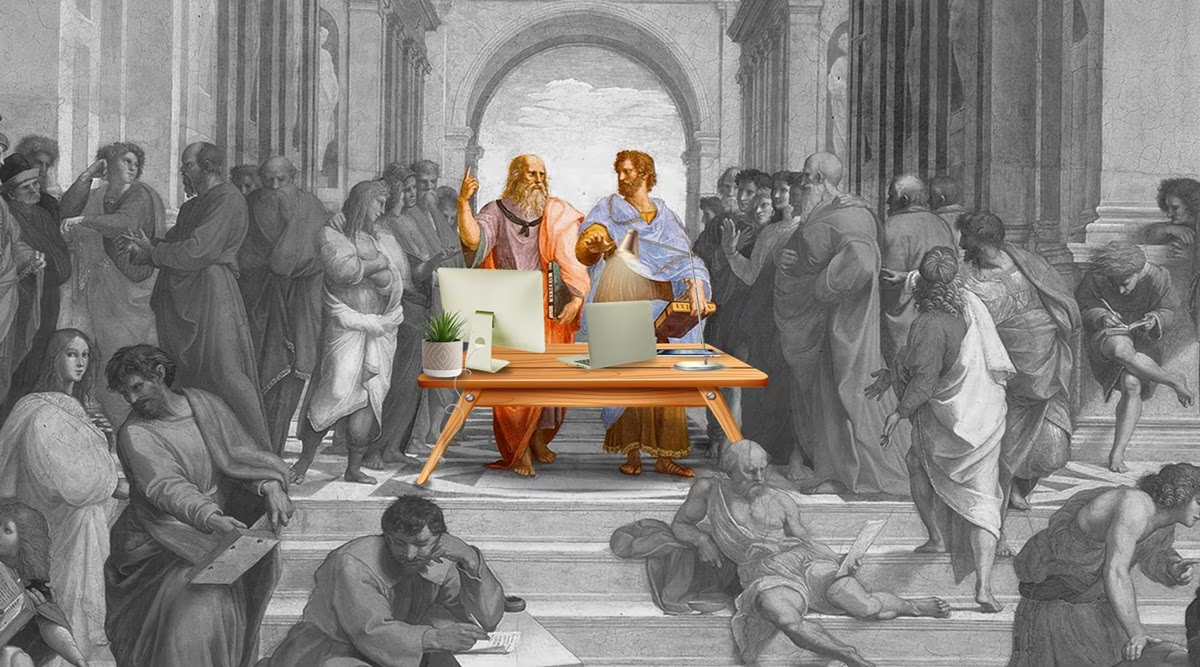
His conviction was not merely that reflection is virtuous. It was that a life conducted without rigorous self-examination is not, in any meaningful sense, a life at all. It is a performance of living, staged for an audience the performer has never thought to question. The Socratic method was not gentle. It was an interrogation of the self so thorough that it left no comfortable assumption standing. Philosophy, in this tradition, is not an ornament for the educated. It is a reckoning.
The person who does not read cannot follow this argument to its end. That is not a coincidence. That is the point.
Epictetus, who knew bondage not as metaphor but as the literal condition of his body, arrived at a conclusion so luminous it has outlasted every empire that surrounded it. He understood, from the inside of suffering, that the only sovereignty available to any human being is the sovereignty of their own rational faculty. External circumstance, the appetite of fortune, the cruelty of other men, none of these touch the innermost citadel of the person who has learned to distinguish what belongs to them from what does not. This is the Stoic architecture of freedom, and it demands a mind disciplined enough to hold the distinction under pressure. It is a philosophy that earns nothing for those who merely encounter it. It transforms only those who practice it with the full weight of intellectual seriousness. Wisdom of this caliber does not yield to casual acquaintance.
Sartre arrived at the twentieth century and found a world in ruins, morally and architecturally, and declared into that rubble that existence precedes essence. What he meant was incendiary. No god, no nature, no tradition has written your character in advance. You are not the inheritor of a fixed self. You are the author of one, composing it through every act of will, every choice made or evaded, every moment of courage or its absence. The terror of this freedom is proportional to its grandeur. To understand Sartre fully is to stand at the edge of complete responsibility for the shape of your own soul, with no authority to deflect that weight onto. This is not a thought for the faint of mind. It is an idea that opens only to those who have trained themselves, through reading and sustained reflection, to hold complexity without flinching.
So how does an examined life is worth living where philosophy is concerned? Because philosophy directs life. Because it is the only discipline that insists on looking at life whole, refusing the comfortable fragment, the inherited verdict, the borrowed conviction. It is the art of thinking carried to its most demanding conclusion. And like all arts practiced at their highest register, it speaks most fully to those who have prepared themselves to hear it. It does not condescend. It does not simplify. It waits, with infinite patience, for the reader who is ready to be changed.
Leave your comments below for discussion!